Practising Prayer with Lancelot Andrewes: A Seven-Day Devotional
Nicola Eggertsen
Biblical Counselling UK, 2024, bcuk.org pdf digital download, 27pp)
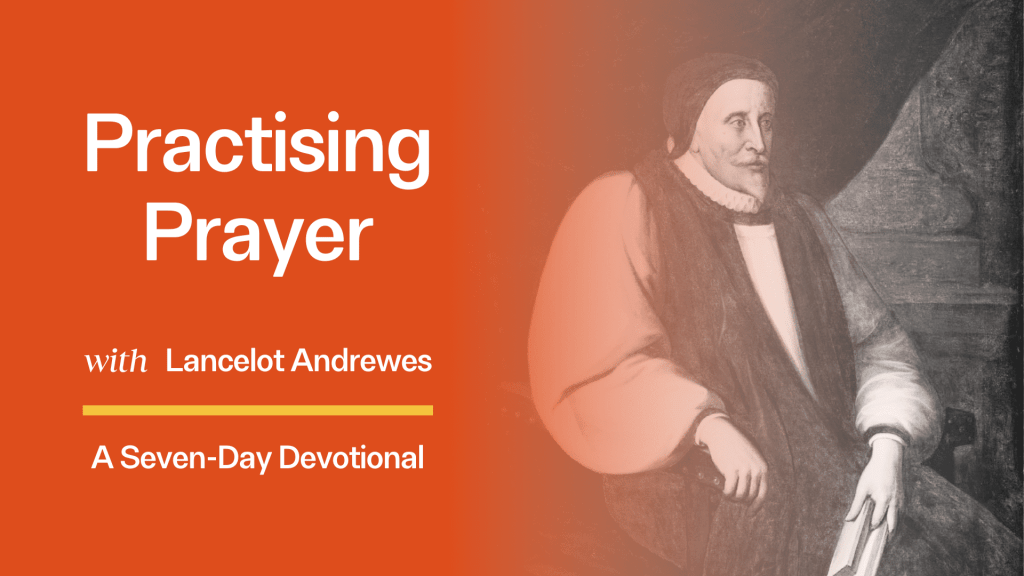
A Seven-Day Devotional
Nicola Eggertson
The eagle-eyed will not fail to notice the quotation circumventing the title of this small pamphlet. A bible verse? No. A quotation from the Bishop of Winchester, Lancelot Andrewes (1555 – 1626), contemporary of the Metaphysical poets, beloved of T.S. Eliot, fellow of Pembroke College, Cambridge and scholar involved in the translation of the Authorised Version in the time of James 1.
“At all times we stand in need of God’s particular assistance. Whether it be in the night, or morning, midday or evening, at home, or abroad, in the city or country, in our beds, or at our work, if we call upon him faithfully, he will hear us.”
Which of us has the discipline, or is yet sufficiently grace-filled to recognise this need and act upon it consistently? Few of us if we are honest and so it is with particular enthusiasm that I recommend this title, providing structure and guidance for those whose minds, during prayer, are prone to wander. In other words, everyone.
The book is described by Eggertsen, a former English teacher and tutor/grader for BCUK, as a “7-day plan, loosely modelled on the Lord’s Prayer, full of specific scriptures and ancient prayers with which we can call out to God.”(3) It resembles in spirit and purpose McKelvey’s ‘Every Moment Holy’ series and Jonathan Gibson’s works, in embryo (and more portable though not so beautifully produced) form.
For those in the midst of struggle of whatever sort Andrewes’ title provides a much-needed structure for devotions based in scripture and adorned with the ancient prayers of the Apostolic Fathers.
Like John Baillie 300 years later with his A Diary of Private Prayer, Andrewes has written a ‘private’ prayer book (Preces Privatae) responding to the Lord’s injunction to “go into your room, and when you have shut your door, pray to your Father who is in the secret place” Matthew 6:6 NKJV. Is not the Lord’s invitation irresistible when our own words fail us or tears overwhelm? This guide will help us.
Eggertsen has here sought to “condense, simplify and modernise” Andrewes’ original language for contemporary use and has interspersed the re-worked text with her own suggestions for personal reflection (encased in text boxes). She does not claim it to be a scholarly work; but, rather, “a personal reimagining of a small section of a 400-year-old prayer book that has blessed me in my walk with the Lord” (BCUK Blog post July 11, 2024).
Where Gibson’s beautifully crafted Be Thou My Vision and O Sacred Head, Now Wounded or McKilvey’s liturgies can offer up to an hour or more’s rich, devotional time, this little prayer book asks 10 minutes of the pray-er and can be used as part of one’s daily devotions or as a devotional in itself. As with Milton Vincent’s A Gospel Primer, smaller sections at a time can be digested allowing personal rehearsal of the gospel where time is tight. Crucially both heart and mind are brought to prayer as we still ourselves in body for long enough to meet with ‘God most High’ and enjoy His assistance.
Andrewes adopts the structure of, and borrows from, the Book of Hours (The Horlogian) a prayer book originating in the Eastern Orthodox Church which provides fixed prayer times within the canonical day. There are 11 scriptural sections (from Morning Verse, through to Praise) also including daily references to the Apostles’ Creed. Eggertsen supplies a very useful and accessible schedule at the front of the book for reference, resembling a school timetable – a visual tool for those whose prayer lives feel like unravelled wool garments.
What is particularly attractive about this re-working of an ancient text is the way that Eggertsen gently weaves pastorally sensitive and insightful questions into the various sections each day. A taster of her tone is given below and is taken from the first day of the week, Sunday:
“Even our prayer times are tainted by our own self-interest and sin. Our kind Heavenly Father already knows this, and he still invites us to come and talk to him. Take a moment to reflect on the scriptures below considering the following questions.
What appeals to me more than the Lord’s love?
What am I clinging to?
What do I fear most?”
…there then follow suggested verses on which to meditate e.g. Ps 86:15; Ps 41:4; Romans 7:24; Jonah 2:8.
Petition is a word familiar to us; ‘deprecation’ and ‘comprecation’, words which Andrewes uses within this discipline, perhaps less familiar. Eggertsen defines these words for us without affectation: Deprecation – i.e. Lord please take away from me/rid me of…; Comprecation – i.e. Lord please give me/work in me…’ She thus highlights the distinction between the focus of Petition (prayer about the state of the garden of one’s own soul) and the focus of Intercession (prayer about the state of the world outside). Bookended in this way our prayers neither become too introspective nor exclusively outward in their focus.
The resource is downloadable and free and can be carried about during the day on one’s phone, although a format for smaller devices would be welcome. Whatever approach you take, no section should be rushed as Eggertson points out in in her own review of the title on the bcuk website. Are not the summer months, often being slightly calmer than other times of the year, a good opportunity to taste this new devotional approach? Perhaps the best recommendation is a personal one – I’m already finding the resource both a comfort and a challenge in my own struggle with prayer.

 Roques Reviews
Leave a comment