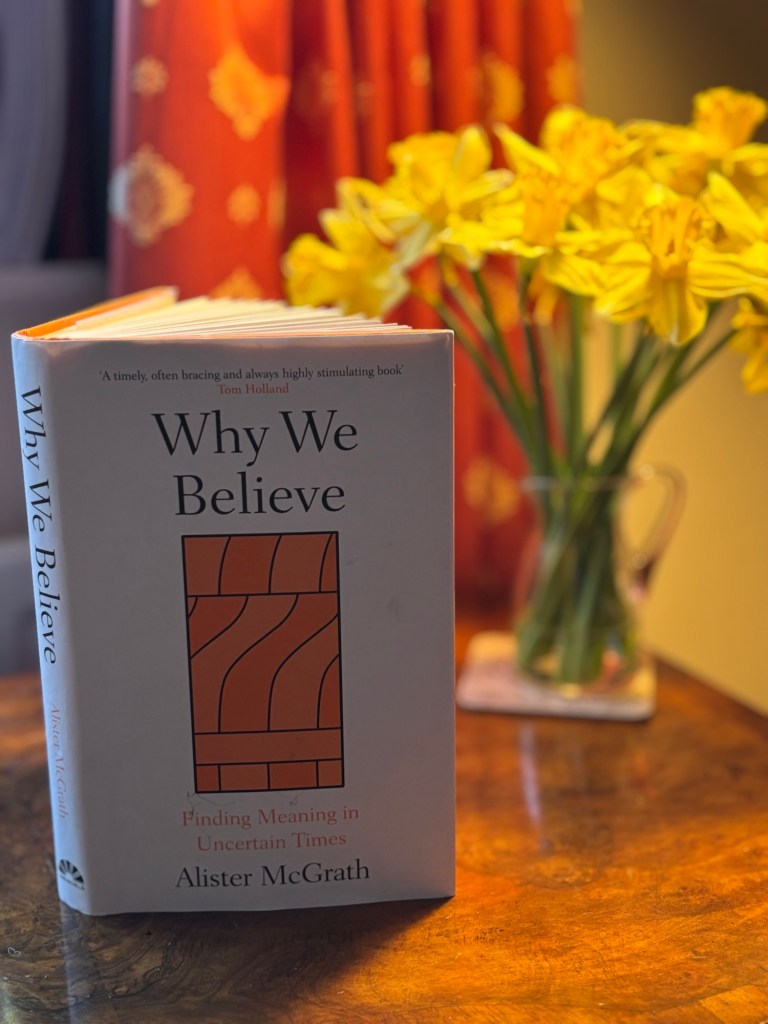
Why We Believe: Finding Meaning in Uncertain Times
Alister McGrath
OneWorld Publications, 2025 (ISBN: 9780861549214 hb, 230pp)
Alister McGrath
To presume to review anything written by Alister McGrath, author of over 50 books, acclaimed public intellectual, historian, scientist and holder of three Oxford doctorates is to take on, not a critique of the text, but rather a consideration of its accessibility to his readers very few of whom will boast of such a scholarly profile.
Why We Believe joins the category of his other works of popular theology (e.g. Why God Won’t Go Away, The Dawkins Delusion and Surprised by Meaning) and “argues for a recalibration of the notion of ‘belief’” (4) looking at the role it plays in individual lives and the wider community. Is it possible to live meaningfully in a world of uncertainties? What is the place of evidence in any belief system? Can we rightly call ourselves human without the category of belief? Such questions hold universal relevance whether for artist or scientist, sceptic or believer, secular or religious, intellectual or otherwise. If Einstein acknowledged that human beings need more than what a “purely rational conception of our existence” (13) can offer, then it is no surprise that we too share the same hunger. Where do we look for our guide to reality, to what is right and wrong given that “science offers a descriptive account of how things function; it does not offer prescriptive declarations about what ought to be done”? (14) “Believing nothing is not a serious option” (35) argues McGrath. Belief is a necessary consequence of the very human need to find meaning in uncertainty, to seek out a bigger picture to make sense of our existence.
This idea of the big picture is addressed in his earlier book Surprised by Meaning but notably in this most recent publication, McGrath is more discreet about his own Christian faith mentioning it for the purposes of using it as a worked example to help define religion and argue for it. Only briefly does he speak more
personally about how Christianity “provid[ed] … a stable refuge to weather life’s challenges and a secure base from which I would comprehend and participate in our complex world.” (230) As such, the book would be a good choice for someone exploring faith but wary of over-zealous Christian apologetics.
Chapters address belief from a range of angles examining the notion first broadly and then specifically. Chapter 5 offers a particularly powerful treatment of the difference that believing makes in the context of wellbeing and human functioning. Links between cognition and action, theory and process are outlined
before the sensitive but necessary topic of “the dark side of believing” (167) is addressed. Part of what makes McGrath such a successful writer is his concise written style which blends day to day language with erudite references and complex ideas. Readers are kept on track and able to appreciate the
wider points being made even if, for example, the “principle of the ‘Methodological Exclusion of the Transcendent’” (124) eludes!
Someone reading McGrath for the first time will enjoy the coherence of structure, lucidity of language and universality of appeal. Despite detailed exploration of subjects about which many readers may have no knowledge, the book succeeds in informing rather than confounding, engaging rather than baffling.
McGrath concludes that “belief is natural, reasonable and has the potential for good. To deny it is simply to diminish us as human beings” (217). There will be many who disagree, whose minds are sufficiently satisfied by the answers given by scientific enquiry. It is precisely those people who would be best served
by reading this book, but it is precisely those people who probably never will.

 Roques Reviews
Leave a comment