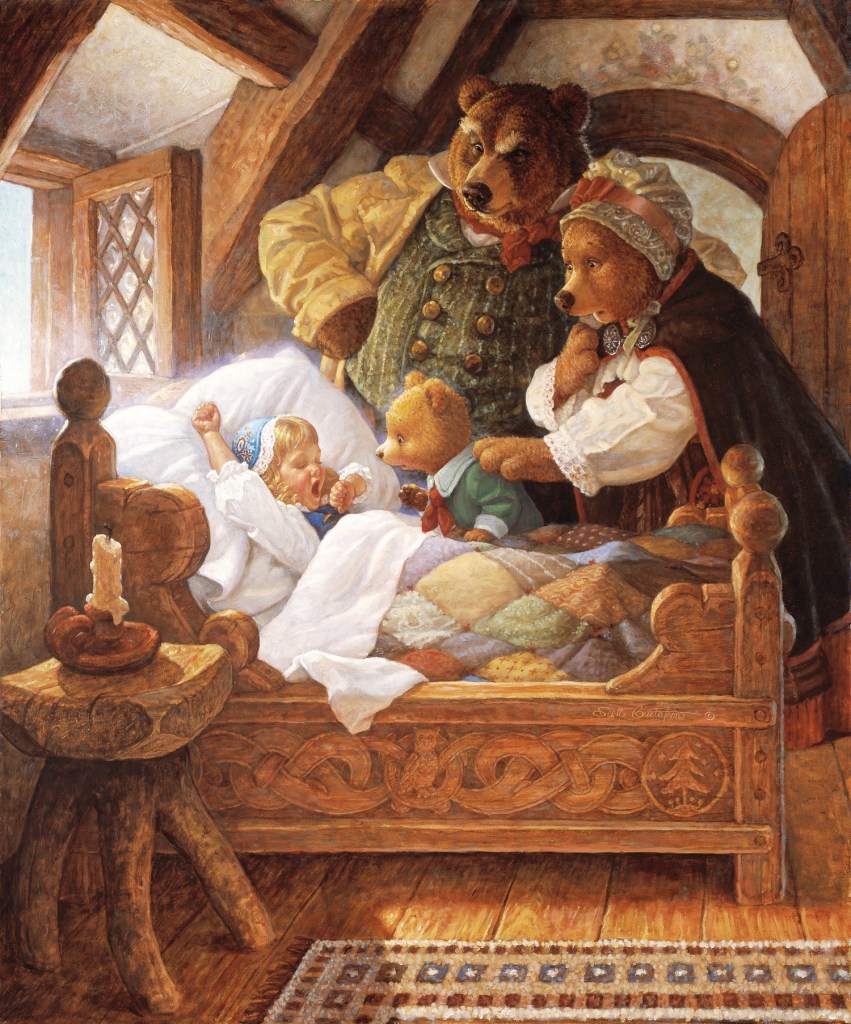
“Now the three bears had gone out to walk a little before this. They were the Big Bear, and the Middle-sized Bear, and the Little Bear; but they had left their porridge on the table to cool. So when Silver-hair came into the kitchen, she saw the three bowls of porridge. She tasted the largest bowl, which belonged to the Big Bear, and found it too cold; then she tasted the middle-sized bowl, which belonged to the Middle-sized Bear, and found it too hot; then she tasted the smallest bowl, which belonged to the Little Bear, and it was just right, and she ate it all.”
The Three Bears, Robert Southey
There are many versions and revisions of this classic fairy tale. The protagonist was originally a cantankerous, old woman who, in Eleanor Mure’s 1831 story, intrudes on the home of three bachelor bears. Upon discovering her antics, the three bears deal with her fairly violently first trying to burn and then to drown her. Unsuccessful in these attempts, they instead “chuck her aloft on St. Paul’s church-yard steeple.”

In Southey’s 1837 version, the old woman manages to escape out of the window unharmed although he apparently later speculated that she might, with any luck, be “sent to the House of Correction” for vagrancy, or might have broken her neck in the fall. In 1850 Jospeh Cundall, in A Treasury of Pleasure Books for Young Children, retells the story this time identifying the main character as a little girl – also called Silver-hair. It is not until 1904 that Silver-hair becomes Goldilocks. The three bachelor bears by this time have become the better known family of Daddy, Mummy and Baby bear.
This later story with which we are most familiar is of a young, blond haired girl whose adventure consists in entering the bears’ home, eating from their bowls of porridge, trying out their chairs for comfort and then lying on their beds. In each instance, she finds that of the youngest bear to be “just right” and from this story comes the Goldilocks Principle concerning the optimum conditions between two extremes across a variety of disciplines including physics, astronomy, biology, psychology, business and education.
Goldilocks seeks the perfect temperature for her porridge, the best fitting chair and the most comfortable bed. A Christian can look for a church in a similar way, seeking something ‘just right’. But there is no perfect church, as anyone who goes to one will know. I am thankful to have experienced three types of church all of which have been biblical and Christ-centred. Each, inevitably, has had its own culture, style, size and atmosphere.
One of these churches I would describe as liturgically-framed Anglican, another Spirit-led Charismatic, and another word-based Evangelical. The emphases of each have been different but all remain in sympathy with one another describing themselves as ‘different rooms in the same house’.
God has made each of us differently and what is too ‘cold’ for one will be too ‘hot’ for another. What is just right for him will be uncomfortable for her. The cultural temperature that suits one may burn another.
A very dear old friend, sensitive to the difficulties of making up one’s mind, once said to me, “It is important to know how you like your eggs done.”
“What do you mean?”
“Well, do you like them scrambled, or poached or what?”
“Oh, I don’t know. I’d have to think about it.”
Whilst a finely cooked poached egg is ‘just right’ for me, another might prefer his or her eggs scrambled or boiled or even raw.
Obviously it’s important that the eggs are not ‘bad’, that the porridge is not burnt or the oats stale, but having established that the essential ingredients are good and life-giving, then how we choose to eat is a matter of preference so long as we are feeding on Him, growing in Christ and in our love for Him and one another.
Below is a series of books I’ve found helpful whilst thinking through these issues:
Streams of Living Water – Richard Forster
In this measured and wise 2019 Hodder & Stoughton publication, Richard Foster examines six dimensions of Christian faith and practice: the Contemplative tradition (prayer-filled); the Holiness tradition (concerning-virtue); the Charismatic tradition (Spirit-empowered); the Social Justice tradition (compassion-filled); the Evangelical tradition (word-centred) and the Incarnational tradition (sacramental). Pete Greig has described this book as ‘a seminal title for our time.’
Spirit and Sacrament – Andrew Wilson
Published by Zondervan in 2019, this book invites a uniting of two traditions, Eucharistic and Charismatic, which are kept needlessly separate in many churches.
Silence and Honey Cakes – Roman Williams
Quite a dated book now, published in 2004 by Lion, this short and very readable work takes the reader back to 4th century desert fathers and mothers and their practices drawing connections with our own modern day approaches. Williams’ own reflections are very human and accessible and make what at first seems an inaccessible read highly palatable.
Also by Rowan Williams – Being Disciples, Holy Living and Being Christian
More – Simon Ponsonby
Published in 2010, this book by Oxford based Pastor and Theologian, Simon Ponsonby addresses the hunger many experience for ‘more’ of the Holy Spirit. An evangelical/charismatic audience is largely assumed.
The Imitation of Christ – Thomas à Kempis
Now available in modern translations though the older language is perfectly accessible, this terrifically challenging read, thought to be the most influential Christian devotional in history, has stood the test of centuries.
Introduction to the Devout Life – St Francis De Sales
Another ‘classic’ first published in 1608 at about the time that Shakespeare wrote ‘Antony and Cleopatra’ and John Milton was born. The book consists of personal letters written to Philothea, the ‘lover of God’ instructing the reader in how to approach God in prayer and the Sacraments as well as offering remedies against ordinary temptations.
Emotionally Healthy Spirituality – Peter Scazzero
Recognising the dangers of a growth in head knowledge, Scazzero exposes the dangers of a lack of emotional health lurking beneath the surface of an outwardly zealous and respectable life of service. A biblical integration of spiritual practices and emotional maturity. Published by Zondervan.
Falling Upward – Richard Rohr
Written by a Franciscan Friar, this thoughtful, contemplative, erudite book examens the mystery of how failure can be the catalyst and foundation for spiritual growth. Published by SPCK, 2012.
Anglican Spirituality: An Introduction – Greg Peters
An exploration of the Daily Office, Holy Eucharist and Private Devotion through the Book of Common Prayer. This book shows just how much the charismatic, evangelical and Eucharistic ‘streams’ (as Foster calls them) have in common. Very helpful and grounding.
For Thy Great Pain, Have Mercy On My Little Pain – Victoria Mackenzie
Published in 2023 by Bloomsbury and winner of the Scottish Book Awards First Book of the Year, this beautiful, short novel fictionalises an encounter between Julian of Norwich (anchoress and mystic famous for her writings entitled Revelations of Divine Love) and Margery Kempe (an English Catholic mystic) in the year 1413. An exquisitely moving tale.
In my ‘To Read’ pile:
Spiritual Disciplines for the Christian Life – Donald S. Whitney
From the Mouth of God: Trusting, Reading and Applying they Bible – Sinclair B. Ferguson
A Heart Aflame for God: A Reformed Approach to Spiritual Formation – Matthew Bingham

 Roques Reviews
Leave a comment