Good Bad No Dad? A Biblical Reflection on the Father Deficit in Contemporary Society
John Woods
Grace Publications
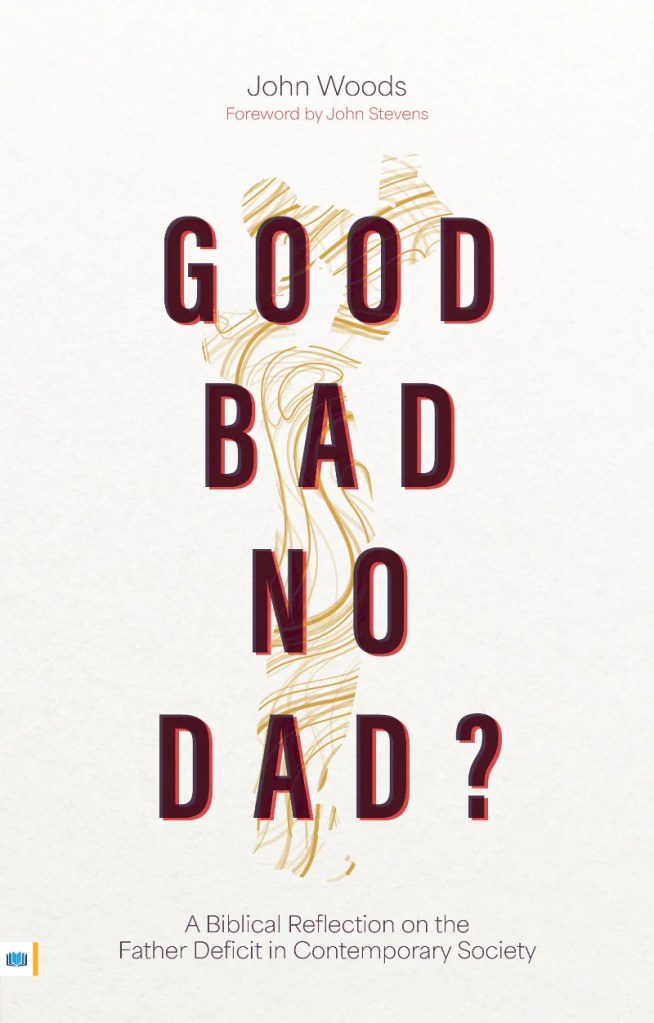
“I might as well come clean: this is personal” John Woods
Could there be a more striking sentence to begin a book on fatherlessness? Whether you are drawn to this publication because you are a church leader, counsellor, friend, or someone for whom the issue is also personal, such moving words make for an arresting opening. “This is my story, this is my wound, and my missing piece.”
John Stevens, National Director of FIEC, who writes the foreword says that “this is a book that I needed to read years ago”. As someone for whom the issue is also personally resonant, I would say the same. Whatever the nature of a person’s experience of fatherlessness, whether through abandonment, estrangement, death or abuse, they will find solace and hope within these 236 pages.
Woods is prepared to make himself raw and vulnerable without being self-pitying or bitter for a moment. There is a very real and compassionate acknowledgement of the pain of fatherlessness in its various forms as well as a very brave consideration of the question of whether a person can actually recover from this lack.
The reader, if he or she relates to the issue at all, cannot help but feel personally pastored by this wise, biblical, hopeful, consoling fellow traveller.
Structure and Relevance
The book asks a question of huge relevance for today – What does it mean to be fatherless and why does it matter? Woods draws on three sources for his material: a wide range of personally conducted interviews with individuals who have suffered fatherlessness in some form; Old and New Testament examples of fatherhood from Cain to David, Joseph to Paul and finally from a study of God the perfect Father as found in scripture and, in particular introduced to us by Christ in the gospels, His Father and ours.
Chapters include questions, prayers and practical suggestions for action as well as quotations from literature, songs and the work of both secular and Christian writers all of which throw yet more light on this multi-faceted diamond of a subject. Woods is more qualified than most to speak to the issues and writes personally and openly about his own experience of fatherlessness.
Woods does not shy away from the difficult topic of child abuse and actively looks for ways in which the bible can be brought to bear on a situation in order to help support victims and survivors. The book mentions the scandal concerning John Smythe and others and Woods is clearly aware of how issues of trust relating to father-figures in a church context have become rife. Whatever the situation, the reader is encouraged to view it through ‘gospel lenses’ and seek practical help whilst also pursuing forgiveness.
The Interviews
Interviews, sometimes anonymous, at other times cited are transcribed verbatim which, whilst lending an air of raw authenticity, would benefit from minor editing and linguistic tidying at times to make their meaning clear. They are not polished answers prepared for print – they are the real response. Amongst such a wide range of voices and situations, it is almost certain that one or other will resonate with a reader’s own experience or that of the person they may be seeking to help. These interviews are distressing to read and not for the faint-hearted.
Greater sensitivity to this issue within the church is clearly a concern for Woods as it is for Steve Midgley in his recent book Understanding Trauma, a book it would be well worth reading alongside, though dryer in tone. Woods courageously asks interviewees for their perspective and feedback on how the church could better support its members in this area. Giving sufferers a voice within the text gives the book a leading edge in sharing the hearts of individuals for whom this is a very real and present issue in their lives. There is no theorising here. No cold analysis of researched data or psychological findings but rather a living conversation with a mission to raise awareness and improve pastoral care.
“One of the things I would like this book to accomplish is to create a safe environment where people can be honest and vulnerable about how they feel and seek help in exploring how to deal with [their emotions]”
He goes on to say “Perhaps hearing echoes of their own stories in those of other people will act as an arrow of hope that points to the reality that they are not the only ones who have experienced this.” I for one would confirm that he has achieved this goal. At times, I felt he was seeing into my soul.
Old Testament Examples
Speaking about the story of Josiah, Woods writes “I find this story so encouraging. It does not matter how disastrous a start you have in life; God can turn it around. In life, even for the fatherless, it can be darkest before the dawn. Like Josiah, I can be different to the bad example I had. The God of the Bible is the God who breaks through the darkest of stories.” A beautiful section on Old Testament images of God the Father in Deuteronomy (Carrier, Trainer, Eagle) encourages a view of God which can inform our own parenting.
New Testament Examples
New Testament examples of father-figures include Joseph and Paul. Readers are encouraged to consider how they, too, might come alongside others in a paternal role wisely suggesting that they await an invitation in the light of recent abuses of power.
Woods looks at how the gospel narratives themselves address fatherlessness with a focus on Jesus’ own teaching on the Fatherhood of God. Woods asks “in what ways does the gospel begin to fix the Father deficit, how does it fill the hole, heal the wound, replace the missing wires?” Jesus’ death on the Cross is the means through which we can know an unhindered welcome from the Father.
“One of the most important things about the Christian life is knowing that we are loved by God as a fact and growing in an awareness of that fact in our experience. This is not an automatic thing. We need to keep preaching the gospel to ourselves.” But not just to ourselves. What better way to end than to encourage us to think about how we can “put our woundedness [to use] in the service of others”, pointing one another to God for healing and restoration.
Universal Appeal
“When you feel that you have not made the grade or that you do not fit in, it can have a dramatic psychological impact on a person. Some of the ways that this can manifest include trying too hard to impress, being overly defensive, and taking rejection badly. It is a great gift and a blessing to live at ease with yourself, not always feeling that you have something to prove. When we feel that every word we speak and every action we perform needs to be justified, we become prisoners to our insecurities.”
My hunch is that more readers than care to admit it will relate to these words.

 Roques Reviews
Leave a comment