Battlefield of the Mind for Kids: A Kids’ Guide to Battling Fear, Doubt and Worry
Joyce Meyer with Tama Fortner
Hodder & Stoughton, 2025, (ISBN: 9781399824743 pb, 213pp)
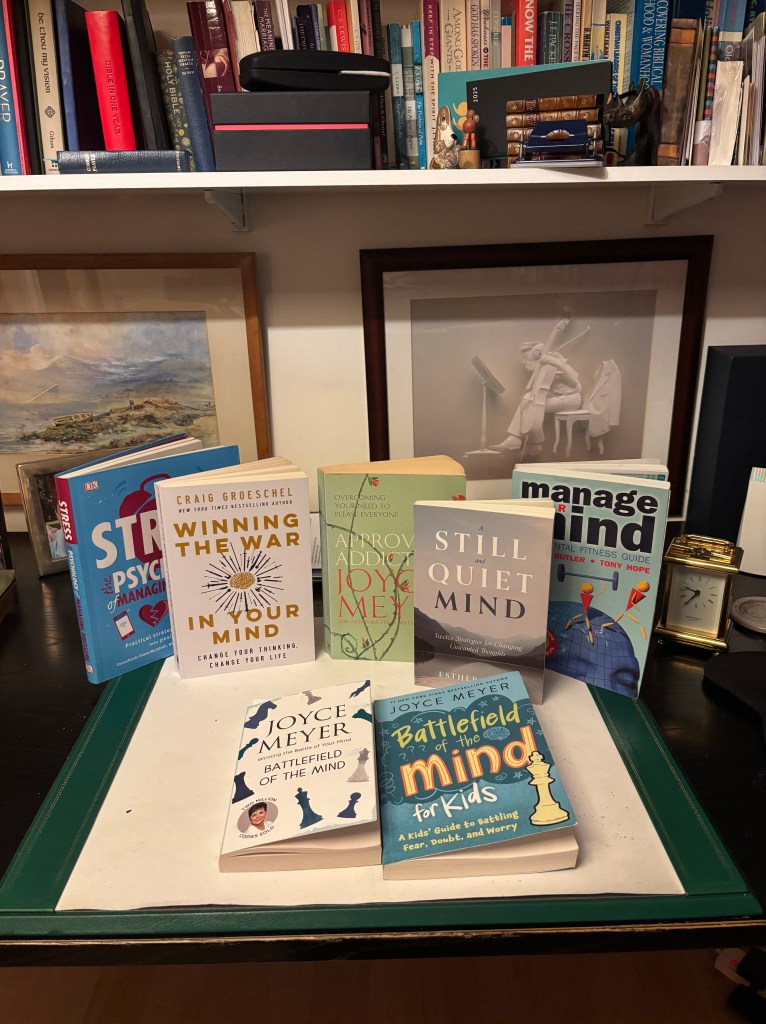
Joyce Meyer’s Battlefield of the Mind for Kids aims to equip children with tools to confront negative thought patterns, offering an accessible adaptation of her bestselling adult work for a younger audience. A further book, Battlefield of the Mind for Teens is also available. With eye-catching page layout, lively illustrations, and engaging storytelling, the book has the potential to help children between the ages of 8 and 13 grasp the importance of mental discipline within a biblical framework. While not without its theological shortcomings, Christian families and ministers seeking to disciple young minds in today’s media-saturated, anxiety-prone culture would benefit from reading the book.
The premise is straightforward: our thought lives matter deeply, even (in fact, especially) in childhood. Meyer introduces her readers early on to foundational Scriptures such as Romans 12:2 and Philippians 4:8, emphasizing that spiritual transformation begins with the renewing of the mind. The verses are presented out of context but her goal is pastoral encouragement over exegetical precision. Here we find a child-friendly invitation to consider the moral and spiritual weight of our thought patterns.
Children are shown how to ask themselves important diagnostic questions: Why are these thoughts in my head? Are they from God? Should I kick some of them out? These prompts, though deceptively simple are theologically relevant. Reminiscent of the basic principles of cognitive behavioural therapy (becoming aware of and questioning one’s own thinking), they serve well to awaken children to the shaping influences both around them (their peers to the media) and within (their internal insecurities). The concept of “Thought Shapers” is introduced to help children identify those external and internal voices that form their moral judgements and their sense of self. The language is accessible, the tone warm, and the structure highly interactive.
The book does an admirable job of making daily spiritual disciplines appealing and attainable. Quiet times, prayer, and Bible reading are all introduced, not as burdens, but as “training tools” in a child’s spiritual formation. Devices like “Prayer Boxes”, “Training in Truth” exercises and “What would you do?” scenarios make these pages a resource that could readily be used in small groups or at family devotions.
Yet the book is not without weaknesses. Theologically, there are moments where Meyer engages with a form of Christian self-help that risks downplaying the power of the simple gospel, the necessity of grace and the role of the Holy Spirit. The definition of peace, for example, is reduced to “a calm, safe feeling” rather than the objective peace with God achieved through Christ. Similarly, Meyer’s definition of doubt is presented as a negative, defeatist mindset rather than as a serious and intelligent wrestling with biblical truth. Any struggling Christian, adult or child, will know that it can be tempting to lean more towards psychological wellness theory than scriptural experience.
The book also suggests idealistic behavioural goals—such as going an entire day without judging anyone—without sufficiently grounding the reader in the gospel truth that we all fall short. In the absence of stronger emphasis on the role of the Holy Spirit and the necessity of Christ’s righteousness imputed to us, the effort to renew the mind risks becoming an exercise in moralism. That said, the book does make occasional gestures toward divine assistance, (“God is with you every second of every step to help you” and “The Holy Spirit is hard at work trying to help you understand things about God and live a better life.”)
These criticisms are not intended to overshadow the book’s core value. Meyer’s tone is consistently gracious, her style highly readable, and her pastoral instinct commendable. Children are not treated as passive consumers of spiritual truth but as active participants in their own spiritual formation. While not a substitute for rigorous catechesis or gospel-centred teaching, Battlefield of the Mind for Kids is a useful supplement—especially for children already receiving sound instruction at home and church.
For Christian leaders, the book offers a bridge between biblical counsel and practical discipleship for children. It may not tick every doctrinal box, but it undoubtedly points in the right direction: toward a life shaped by Scripture, sustained by prayer, and governed by an awareness of the battle raging within. I have found that reading children’s Christian books as an adult is always a blessing reminding me of Christ’s invitation to enter the kingdom of heaven as a little child.

 Roques Reviews
Leave a comment