by Julian Hardyman
10Publishing
a division of 10ofthose.com
Not very long after coming to faith in Christ at University and beginning a stumbling walk with God, pouring out my heart un-self -consciously to Him about anything and everything in my mind, I was recommended a book on prayer which sadly stole away with that first confidence and assigned it to ‘cold storage’ for almost thirty years.
The book was written by an acclaimed theologian much celebrated by Christians across the globe for the quality of its academic, biblical writing. My family and I once spied the author avoiding the Christian masses gathered for the Keswick Convention by attending Morning Prayer at an Anglican Chapel in the remote village of Applethwaite in the Lake District. The book in question promoted a highly biblical and godly pattern of prayer but one which succeeded in inhibiting me from feeling able to ‘be myself’ with God thereafter.
Jesus speaks of going into your room and praying to your Father who is unseen (Matthew 6:6) echoing one of many Old Testament invitations to pour out your heart. (E.g. Psalm 62:8; Lamentations 2:10; 1 Samuel 1:15) There’s not a lot of point in pursuing a one-to-one relationship with a person if you cannot be honest with them but I don’t believe I am alone in having a sense of anxiety about getting prayer ‘right’.
Some of the following inhibitions crept into my prayer times and I dare to hope that in admitting these, they may resonate with someone somewhere:
- I must not pray about myself. This is selfish and I should be praying about others.
- I should be praying about mission.
- I should pray using biblical language at all times.
- God is more interested in my holiness than my happiness and so it really isn’t appropriate to go to Him when I’m upset about something silly.
- If I’m not spending at least the first ten minutes of my prayer time in adoration and worship then I’m not really praying.
- If evangelism is not high on my prayer agenda then I am not a very good Christian.
As far as I can remember no-one has actually said any of these things to me and neither did the book say these things in so many words. Rather, having a particular personality-type with unfortunate thinking biases means that weeds grow quickly and, unless regularly tackled, rooted out and burnt, take hold.
I do not deny, even for one second, the value of praying for others to come to faith, using the bible as a basis for one’s own prayers, seeking to grow in holiness or praising God. Of course not. What I am saying is that it is very uncomfortable spending time with any person with whom you feel you cannot be yourself. If you perceive in any relationship that you must steer clear of certain topics, always exercising extreme care not to say the wrong things then a sort of hyper-vigilance characterises one’s prayer life making it joyless and eventually neglected. Everyone knows that a garden neglected becomes a task to be dreaded.
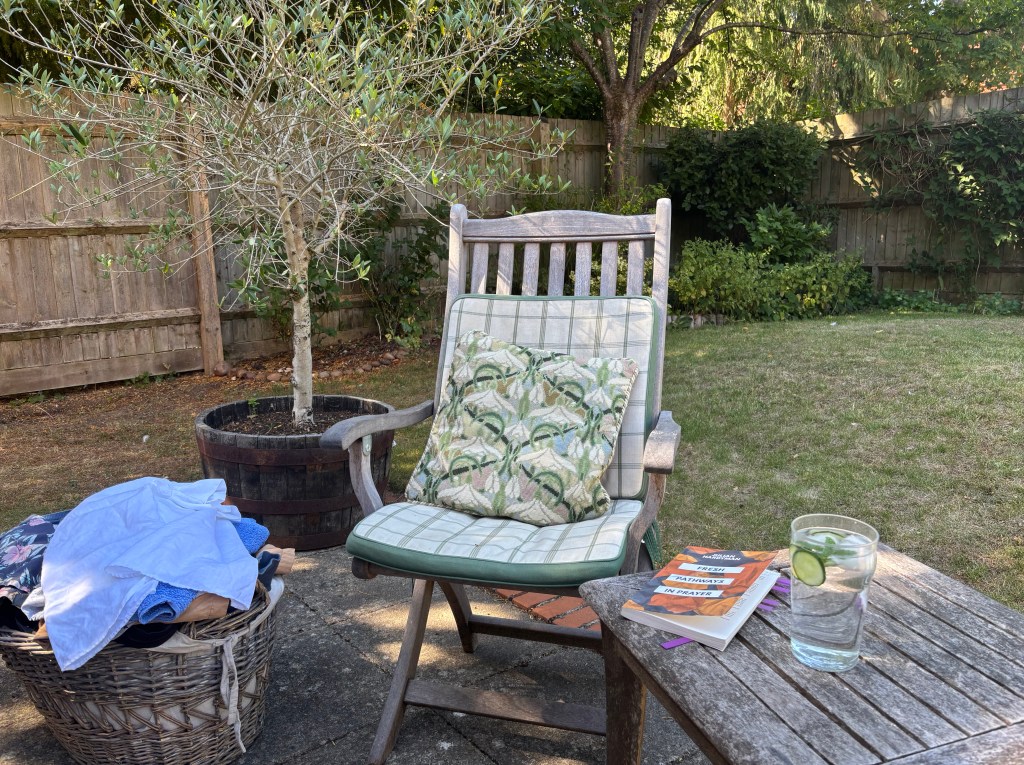
In an attempt to get my prayer life ‘back into shape’ I recently read Julian Hardyman’s Fresh Pathways in Prayer and found myself addressed in a tone so pastorally sensitive that I felt given permission once again to open my mouth and speak what was actually in my heart. Prayer need no longer feel like a job interview where the right questions must be asked, the appropriate responses given, the wrong subjects avoided, manufacturing the best impression. Instead, prayer, I was reminded, is an opportunity to ‘get real’.
Chapter headings range from ‘When I feel stuck’ and move through honest hurdles like ‘When I don’t feel like praising him’ and ‘When I feel too rubbish for God’. The book is concise, only 106 pages and can be read in an afternoon. Whilst a suitable book to give away to someone just beginning a relationship with God it is also hugely refreshing for those who have professed faith for much longer.
Plenty of quite mature Christians struggle with prayer – they find what they do unrewarding, or they do very little praying. This book is intended to help those folk.
Each chapter ends with a text box providing thought or discussion-provoking questions and a suggested prayer, the first of which reads as follows:
Lord, I guess you must be working in me or I wouldn’t be reading this. I do want to pray more or for my prayer to be less routine. Will you show me? Amen.
Or, to quote another example:
Lord, thank you that there is no pit so deep that you can’t go deeper, to join me and then lift me up again. Thank you that there is no darkness so dark that your light can’t shine into it with healing power. Amen.
So real. So human. So normal. So accessible.
Another of the book’s particular strengths is that Hardyman encourages a move towards contemplative (and not just meditative) prayer, daring to use the imagination whilst being aware of the dangers of an alternative and un-biblical mysticism – ‘a sentimental, undemanding, wish-washy, low-octane, fat-free version of a relationship with God’
Apps and prayer lists are recommended for those who find these work for them. However, Hardyman also acknowledges just how much of a distraction the phone can be when, however subconsciously, we are avoiding the hard work of actually talking to God. To each their own.
Whilst Hardyman gently lowers the bar for those who’ve all but given up praying, he nevertheless paints an alluring picture of what prayer might become and shows the reader, literally one step at a time, how he or she might aspire to a higher-jump.

 Roques Reviews
Leave a comment