Cultivating Attention in a Distracted Culture by Aimee Joseph
No one wants to be ignored. It is an upsetting experience. Its effects can linger for a day, a month, possibly years. Confusing and perplexing, being disregarded hurts. Some brush the experience off more effectively than others but most would agree that no one enjoys being overlooked, whatever the circumstances.
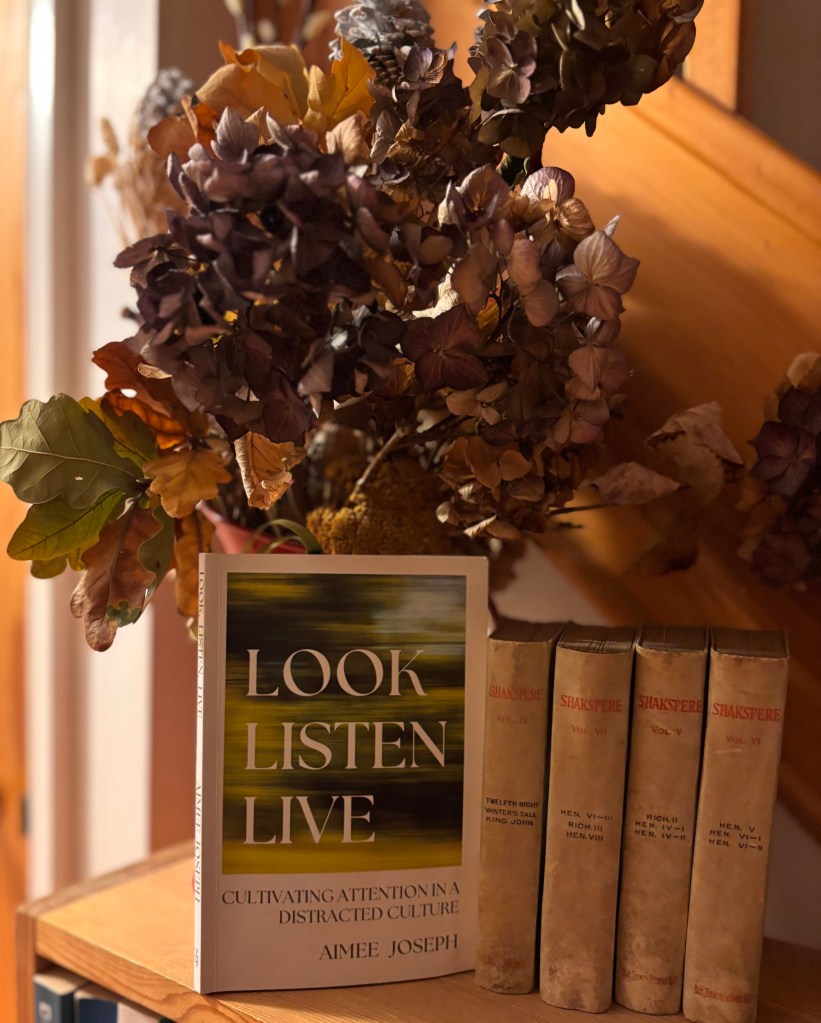
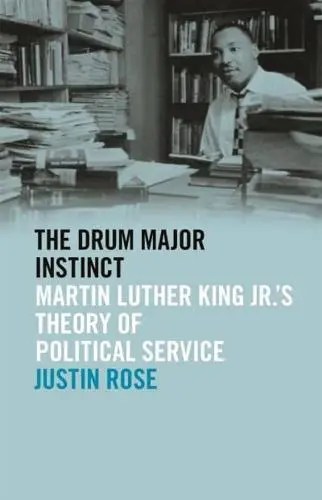
Three apparently unrelated pieces I’ve been reading recently have provided fodder for reflection on this sore topic. Martin Luther King Jr’s sermon The Drum Major Instinct; Anna Funder’s acclaimed biography of Mrs Orwell Wifedom and Aimee Joseph’s little book Look, Listen, Live.
Luther King’s sermon was referenced in a talk I heard recently. I’d not come across it before and so looked it up. The ‘drum major instinct’ refers to the desire to be out front, to lead, to be noticed, to be in a position of importance. It is an instinct shared by all humanity from the moment a baby’s first cry demands that its needs be met. Like any desire, there is a time to express it and a time to refrain from expressing it. Like any desire, it can become disordered and destructive. Legitimate in itself, the desire to be first that this sermon addresses needs to be channelled for good. Sometimes the desire for notice and acclaim must be kept in check. My hunch is that it gets out of control when a person is feeling ignored.

Funder’s biography of Eileen O’Shaughnessy examines what it is for a wife to be ignored. What it is for a voice to be silenced or stolen, what it is to be obscured by self-sacrifice in the service of another who is only too willing to absorb his wife’s talents and call them his own. This brilliant study of Mrs Orwell’s ‘invisible’ life is such a gripping read because it resonates with so many – resurrecting the story and the experience of the woman behind so much of Orwell’s writing who, despite her own literary credentials, remained shrouded and written out of his work.
Aimee Joseph’s little book Look Listen Live reminds me that none of this matters: whether I am noticed, or out front, or in a position of significance in the eyes of the world or live a quiet, unnoticed, hidden life. All that matters is that I fully grasp that there is One who is ultimately attentive to each human soul if he has eyes that have been enlightened to grasp it.
Believers are invited to live under the gaze of their good Father. (P26)
Only when I realise how much He attends to me, will I turn away from other loves and focus on the Father who, alone, is worth of all the attention I have to give to anyone or anything. He never ignores me nor ever will.
Human beings pay attention to those people who interest them. So what is it that makes a person interesting? Achievement? Intelligence? Status? Education? Experience? Family background? Salary? Associates? Followers? Perhaps any or all these things. Perhaps none of them.
A three month old baby gazing, rapt, at a branch of autumn leaves dancing in the afternoon sunlight may captivate an onlooker. What makes that baby so interesting to watch, so delightful, is his interestedness; her total absorption in something other. To be interested in someone or something is to attend to it, to engage with it. To be bored by someone or something is to lose that interest, to disengage.
Are we not a little intrigued if we discover that we have caught another’s attention? We want to be seen. We like to be heard. We long to be known. And yet many suffer from a sense of invisibility.
To what or to whom do I give my attention and whose do I court?
I know that I am distracted from God by the things of this world. More particularly the people in it. Their opinions, their judgements, their approval and affection are coveted and yet constantly elude. God, both ‘attuned’ and ‘attentive’ to me, I am absurdly prone to ignore. Look, Listen, Live reminded me that there is One who holds me lovingly in His gaze even if my fellows here below may not. There is One who approves my efforts to express His image however tentatively and falteringly. Referencing the Genesis account where Abram’s wife Sarai takes matters into her own hands in trying to produce an heir, Joseph writes:
Ours is the God who sees. God saw not only a mistreated Egyptian servant and her child but also a faithless Sarah, whom He still blesses with the promised child. God saw Abram’s passivity yet still graciously enabled him to become a patriarch. The pattern of God’s wayward children and their attentive, gracious God continues as the story unfolds. Though His people continued to look away from Him, He continued to look after them. (P13)
In human terms, to continue to look after (literally, continue to gaze upon attentively) even when the other has looked away is an act of humiliating folly. The rejected young man whose lover has thrown him over does not continue to seek out her company or contact or affection without making himself ridiculous in the eyes of pitying or despising onlookers. But is not this exactly what God does with those who reject Him? He is the greater Lover for it. The adoring attention that only Christ deserves from the Father becomes ours through faith in Him.
The invisibility of our God makes it necessary that we take an imaginative leap of faith to grasp that He can hear us, our very thoughts, our aching breaths as we hold tears at bay, our sighs, our self-talk, our prayers as well as our outbursts, our anger or our words of polite, disingenuous restraint. He sees, He hears and He knows. And He is engaged.
From the throne, He sees, hears, and intimately knows all as an engaged redeemer. (P15)
Many will relate to the following socially searing experience: a person on first acquaintance appears to be interested in what you have to say and responds to your reciprocated interest. Then, for no apparent reason they cease to engage. Today we call it ‘ghosting’. There is a sudden loss of interest; a sudden reversal; a sudden cooling of the temperature which was being enjoyed as a welcome warmth in a cold season. Perhaps some new discovery has caused alarm. The new information proves ‘too much’ and the relational tourist decides he or she has seen enough and turns around to try out another country.
God, knowing everything about us already, cannot reach this point of disillusionment. I will never think or feel or say or do anything that puts Him off. I am fully known and attended to. He does not tire of me nor cease to consider my needs. His attention is constant. He knows He cannot afford to take His eye off me for even one moment knowing how prone to wander I am, waywardly seeking the eyes of some human ‘other’.
“‘Tis God I need, not rank in God
’‘Tis life, not honour’s mead
With him to fill my every mood
I am content, indeed.” George MacDonald, The Disciple
Will I steer this ship on the remainder of her journey away from ‘honour’s mead’ – that heady cocktail of others’ acclaim, affection, approval, attention ever elusive, never consistent, nor guaranteed though perhaps all the more addictive and enticing for it, or will I steer her towards His constant beam, the loving eye of the One who gave up all so that I could experience, enjoy and be satisfied in, His attention alone?
- Mr Palomar – ‘Incorporeal dot’ or ‘fearfully and wonderfully made’?
- The Lord of Psalm 23 – David Gibson
- Look Listen Live
- Intimacy – Deficit or Crisis?
- David Nicholls’ You Are Here: A Refreshing Literary Escape

 Roques Reviews
Leave a comment