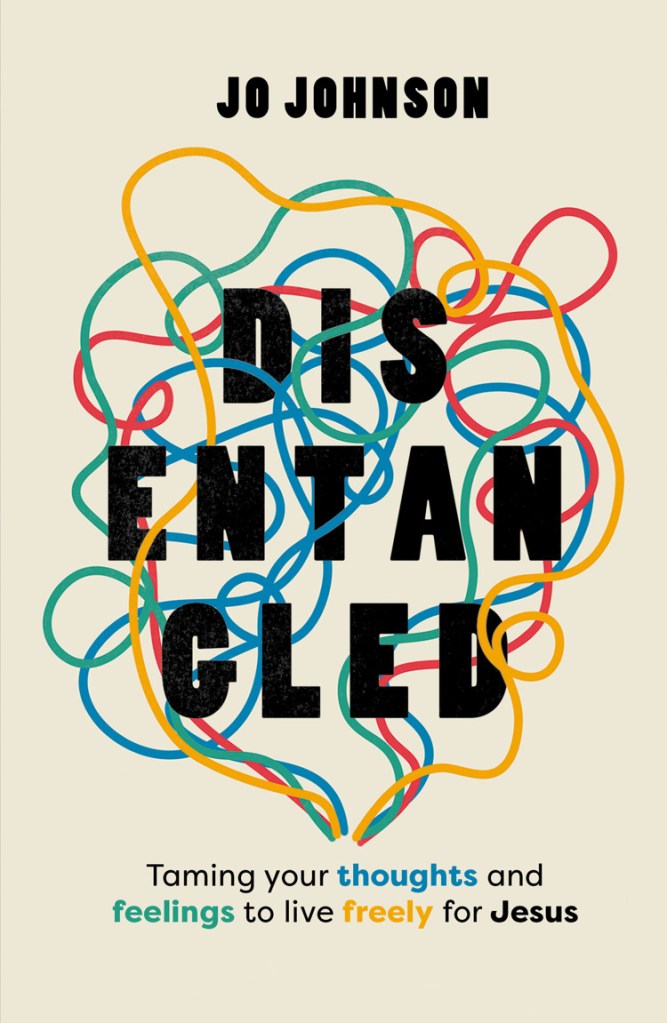
I first encountered this book on Audible, listening to the text read by the author, Clinical Psychologist and Christian wife and mother, Jo Johnson. I then bought a copy intending to read it in text form which, for me personally, is a more effective way to take on board a book’s message. I then felt compelled to give it away before I had actually got round to reading it for myself and so purchased it yet again on Kindle where I freely highlighted large sections of the text which I hoped to remember and put into practice.
A few thoughts below outline why the book is worth listening to, reading and giving away.
Its Title
‘I’ve got myself in a bit of a tangle’. I am not proud of the number of times I have said this over the course of my life. I don’t think I am alone is getting tangled up, particularly when it comes to the life of the mind but I’m perhaps more open about it than some. Jo Johnson is, likewise, courageously transparent and ‘says it how it is’ right from the very first page of this short, readable, practically helpful, Christian book.
It’s easy to tell when your shirt is caught on a nail sticking out of a doorway or a thorn catches in your scarf. To spot when you are entangled mentally requires a bit more practice and self awareness. To believe that it matters presupposes conviction – the conviction that what goes on inside our heads each moment of each day reflects the state of our hearts and affects the way we live life. The going is heavy when the path is overgrown with overhanging branches, uncleared stones, deeply rooted branches across the track ready to trip the unsuspecting wanderer. The author wants to teach us how to clear the path inside our heads so that we can live the lives we want to live and behave in the way that we want to behave – making ‘towards’ moves rather than ‘away’ moves in the direction of God’s values.
Its Tone
Although the book is written for Christians, the author appeals to any who are reading it to persevere even if they don’t agree with everything that is said. The book may well be appropriate to give to a person interested in psychology who isn’t yet a Christian but is, at the very least, open to its claims. The writing is clear, direct, biblical, refreshingly honest, encouraging and reassuring.
Its Tips
Recognising when we have been sabotaged by our thoughts is crucial in order to be able to put into practice the tips that Johnson offers. These range from self-parenting, bringing memory verses to mind, singing Christian songs, turning gospel truths on their head to highlight erroneous thinking, and committing prayerfully in advance to Godward behaviour.
In moments of complete failure, whether in thought alone or manifested in word and deed, the Christian has the extraordinary, mind-blowing relief of knowing that ‘God the just is satisfied, to look on Him (i.e. on Jesus) and pardon me.’ Many have sung these words in church. We know this promise of forgiveness and complete cleansing is real; we sing of it again and again but, functionally, we can live as if the opposite is true looking inwardly at ourselves and then rushing off to try to self-justify through self-promotion or self-protection.
CBT (Cognitive Behavioural Therapy) is a widely recognised therapeutic counselling technique popular with biblical counsellors. Johnson describes her own use of a variant of this – ACT (Acceptance and Commitment Therapy) offering practical, relatable, tangible suggestions as to what choices we can make in the face of our Adam and Eve temptations. We choose. We pray. Sometimes we fail, running to make fig leaves for ourselves; at other times we faithfully hold up our heads recognising, ‘It is finished!’ We are covered and do not need to prove anything, to anyone, least of all God.
Helpful, attractively presented, additional resource materials are available to download and print for individual use if you are serious about getting to grips with managing your mind or helping others to make a start.
Its Trajectory
‘Incurvatus in se’ is a phrase originally attributed to St Augustine and reworked by Martin Luther to describe a person curved in on oneself. It’s a brilliant though frightening image of a person contorted and crippled by their own navel gazing, literally bent over and unable to look up or out.
In his Lectures on Romans (1515-16) Luther describes human nature after the Fall as:
‘…so deeply curved in on itself…that it not only bends the best gifts of God towards itself…but even uses God himself… and seeks all things, even God, for its own sake.”
I often see an older lady who lives nearby walking on the pavement beside the road. She is very thin and no longer young in years. Despite the arthritic condition that bends her back almost completely over, she persists in walking every day, quite long distances. I have seen her many, many times over a number of years. Always walking. No stick. No support. No company except for the small blue plastic shopping bag that dangles from her wrist carrying the few groceries she can manage. Over time, I am convinced I have witnessed the straightening of her back. She is getting better. She is also getting faster, quickly trotting over the road to get out of the way of the oncoming traffic. She is becoming what might be called ‘excurvatus ex se’. It is a wonder and an inspiration to watch her dogged perseverance.
Johnson’s book encourages readers to persevere in the same way as we navigate the life of the mind. We may recognise that we are a mess, yes, but a holy mess and messes who can hold their heads up, without shame because of the covering that Jesus has won for us.
God gifts us with everything we need to change and invites us to partner with him in the process of becoming straightened out.
It is simple, applied, gospel truth and a wonderful read. I commend it highly.


Leave a Reply