By Pete Killingley
Available from The Good Book Company
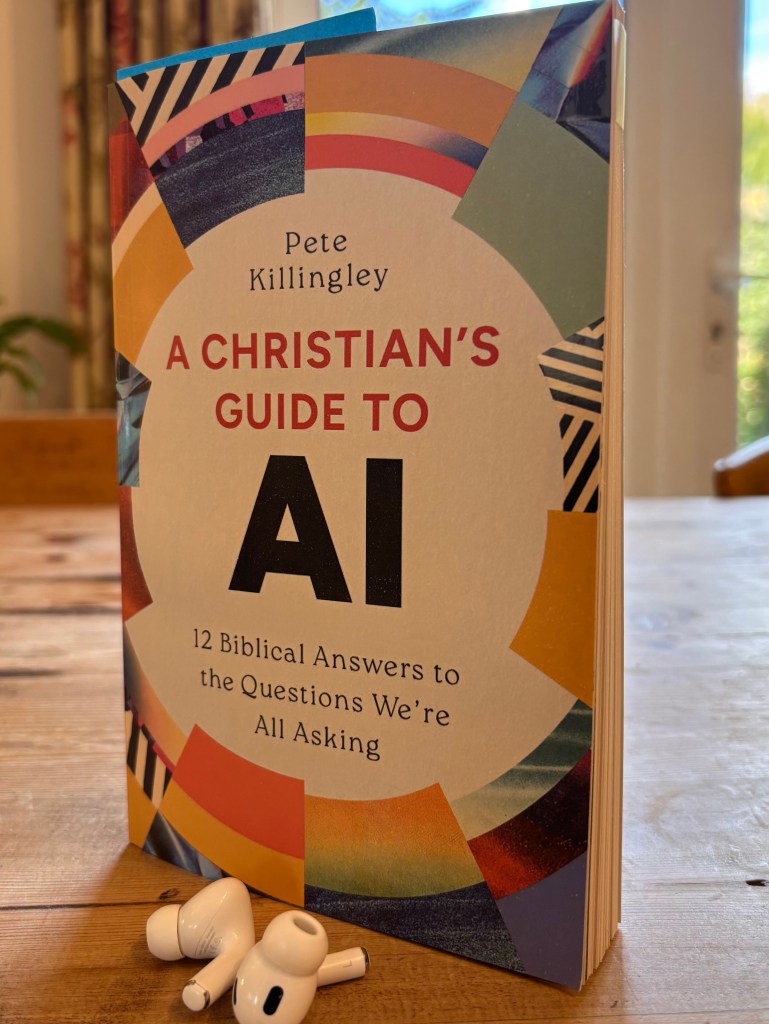
With reassuring transparency, Pete Killingley begins the introduction to this timely, readable, well-researched book with the following assertion:
ChatGPT did not write this book.
AI was used, however, ‘at many points in the process’. Therein lies the dilemma for a writer. How much help, of whatever sort, renders the work no longer your own? At which point does another’s input make a fraud of a writer who puts his name to a text? And if that ‘other’ is an LLM (Large Language Model), how can we be sure that what we read today is the creative work of a human being made in the image of God and not the generated text of what Killingley calls ‘apparent intelligence’?
These questions burn in the minds of any artist but are also relevant for everyone, whether or not they consider themselves a ‘creative’.
Whatever our feelings about AI as individuals, we have an interest in the church’s stance on this fast-moving, emergent reality. Killingley pertinently suggests that the church can either put itself at the ‘forefront of the change’ (11) or leave itself ‘picking up the pieces of the people AI leaves in its wake’ (11) and although the Bible does not refer to AI explicitly it has much to say on the subjects it permeates: work, humanity, technology and creativity to name a few.
AI apparently ‘thinks’ things and ‘knows’ things from the kind of Netflix series we might enjoy to what number a human being is likely to pick when asked to choose at random. Citing, David Betts’ book, The Church and AI who describes Artificial Intelligence as ‘…a human-made simulation of intelligence in a machine’, Killingley encourages the reader to hold the phrase ‘apparent intelligence’ in mind as we proceed. Will AI be a ‘tale of peril, a tale of propaganda or a tale of promise’?
As defined by Betts, AI is ‘human-made’. As defined by Killingley, idolatry is ‘looking to created things rather than the Creator God to protect and deliver us’. And so, as with so many things in our lives that are good, they must not become a god. Just as Eve was tempted by the fruit of the tree of good an evil, will we become tempted by the vast amounts of knowledge AI will deliver and format for us?
It is important that our view of humanity is informed by the word of God if our questions about AI are going to be driven by a concern for God’s purposes. If AI can do for me something that God has gifted me to do myself, am I not abdicating my responsibility to live out my life as God’s poem, His ‘handiwork’ doing those things He has prepared in advance for me to do?
For a reader who hasn’t delved much into AI but is beginning to realise that it cannot be escaped and that basic understanding is not only a requirement but a responsibility, this book is an excellent place to start for the questioning Christian.


Leave a comment